
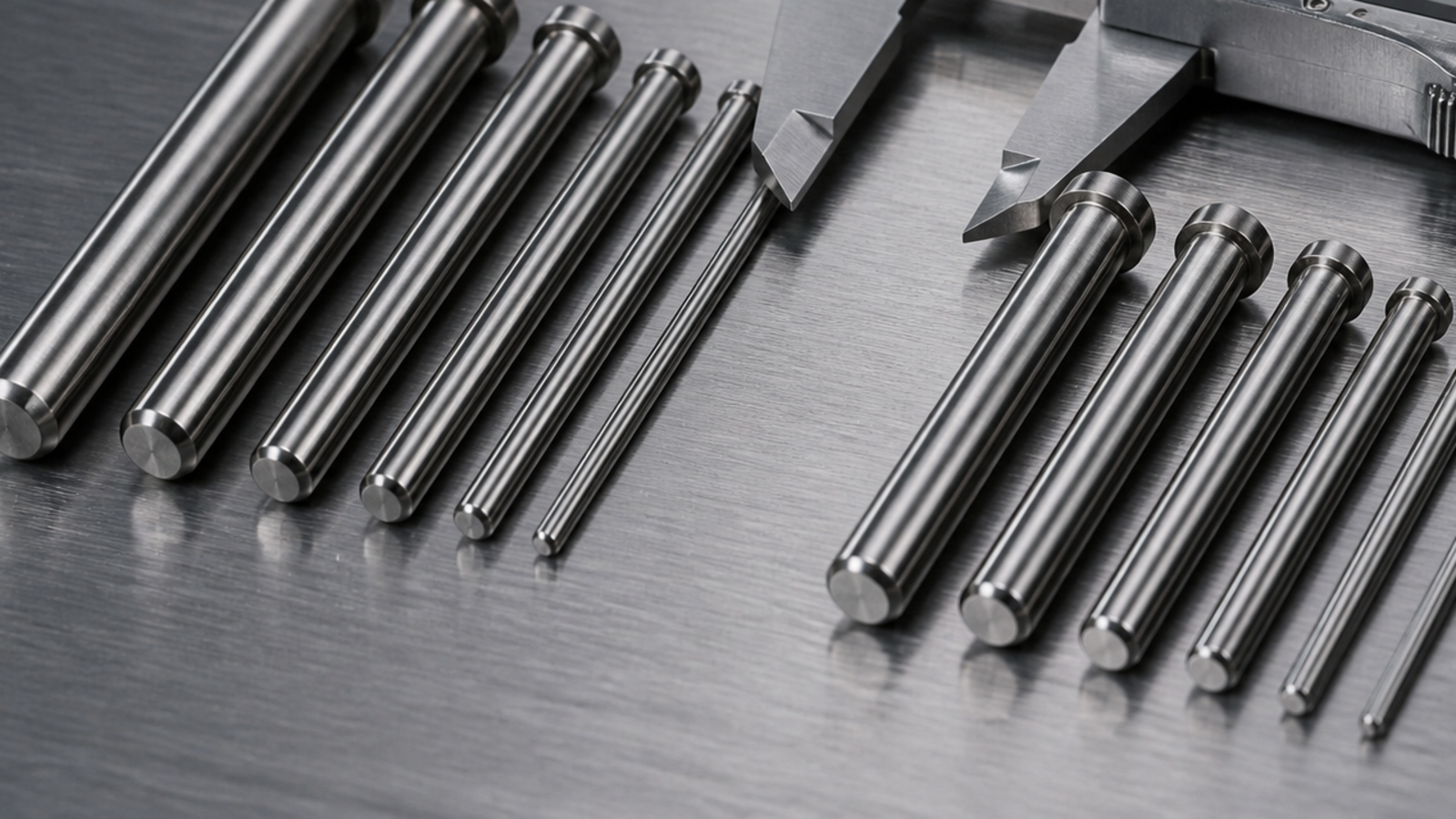
Order in the same system the mold was built in. A North American tool is almost certainly cut for inch pins; one built in Europe or to a DIN-based standard takes metric. The fit has little margin because an ejector pin is a sliding member running in a reamed hole, and the working clearance is a fraction of the pin diameter. A pin from the wrong system misses that clearance, so when you are not certain, match the pin that came out rather than convert a number on a print.
Two standards, two systems
Inch pins follow imperial sizing common in North American tooling. Metric pins often follow DIN standards, with DIN 1530 the common reference used widely in European-built molds and increasingly elsewhere. The two are not interchangeable, and the differences show up in three places that matter at assembly:
- Diameter conventions. Inch pins step in fractional and decimal-inch sizes; metric pins step in whole and half millimeters. A nominal metric size rarely lands on a clean inch equivalent.
- Head style and dimensions. Both systems use a cylindrical head that seats in a counterbored pocket in the ejector plate, but head diameter, head thickness, and the underhead transition are defined differently. A head too thick will not let the plates close; one too thin lets the pin lift.
- Tolerance class. Each system holds the running diameter to its own tolerance band, with a separate, looser allowance on the head. Those bands create the sliding fit, and they do not map cleanly across systems.
The trap is that some metric and inch sizes sit close enough on paper to look swappable. A 6 mm pin and a 0.236 inch pin read like the same part, but the difference is larger than the clearance the hole was reamed for.
Why does a near-miss cause a bad fit?
The clearance between an ejector pin and its hole is small by design. It must be loose enough to slide freely under the ejector stroke and tight enough to keep molten plastic or die-cast metal from pushing past and flashing onto the part. Substitute across systems and you land on one of two failure modes, neither acceptable.
A substitute that runs oversize binds, and under the side loads and heat of a running mold that bind turns into galling, where pin and hole pick up and score each other. The pin drags, the ejector plate stops squaring up, and the system can seize. A substitute that runs undersize opens the clearance past its limit and loses the seal, so plastic creeps up the bore and you get flash around the pin witness and a pin that sticks as the flash cures in the gap. Both outcomes pull the tool for rework, which is exactly what a replacement pin is supposed to prevent.
How do I tell if my pins are inch or metric?
Do not read the system off the original purchase order or assume it from the molder. Measure the pin that came out, and capture enough to order without converting across systems.
- Running diameter. Use a micrometer, not calipers, and read it in both units. A clean millimeter or half-millimeter value points to metric; a fractional or decimal-inch value points to inch.
- Head diameter and thickness. Measure both. The head is a frequent source of mismatch, and the head pocket sets whether the plates can close.
- Overall length under the head. This sets the pin’s reach, and decides whether you need it ground to final length or left long for fitting at the press.
- Any print callout. If the mold print references a standard such as DIN 1530, record it; otherwise lean on the measurements.
A worn or galled pin can read undersize at the damaged band, so take readings on an unworn section near the head and treat a heavily worn pin as a guide to nominal size, not a precise gauge.
When in doubt, send the pin
If a mold is down and you are unsure of the system, send the worn pin. A grinding shop can measure it, identify the system, and reproduce it on the precision grinding operations that hold the running diameter. That avoids ordering twice and ending up with a second wrong part. For more, see getting an exact replacement pin when a mold is down.
Frequently asked questions
How do I tell if my pins are inch or metric? Measure the running diameter of the pin that came out with a micrometer and read it in both units. A clean millimeter or half-millimeter value points to metric; a fractional or decimal-inch value points to inch. Confirm with the head dimensions and any standard called out on the mold print.
Can you make to DIN and to imperial prints? Yes. We manufacture ejector pins in inch and metric to your print or sample.
Can I just swap a metric pin for the nearest inch size? No. The nearest size across systems is off by more than the hole’s working clearance, which leads to binding and galling if oversize or to flash and sticking if undersize. Match the system the hole was reamed for.
Do I need the print, or is a sample enough? A sample is usually enough, since the pin carries its own diameter, head, and length. The print helps when it names a tolerance class or standard, or when the worn pin is too damaged to measure reliably.
Inch or metric, made to your print
Precision Core Pins manufactures ejector pins in inch and metric to your print or sample in Orange County, California. Call (714) 540-5621 or request a quote.