
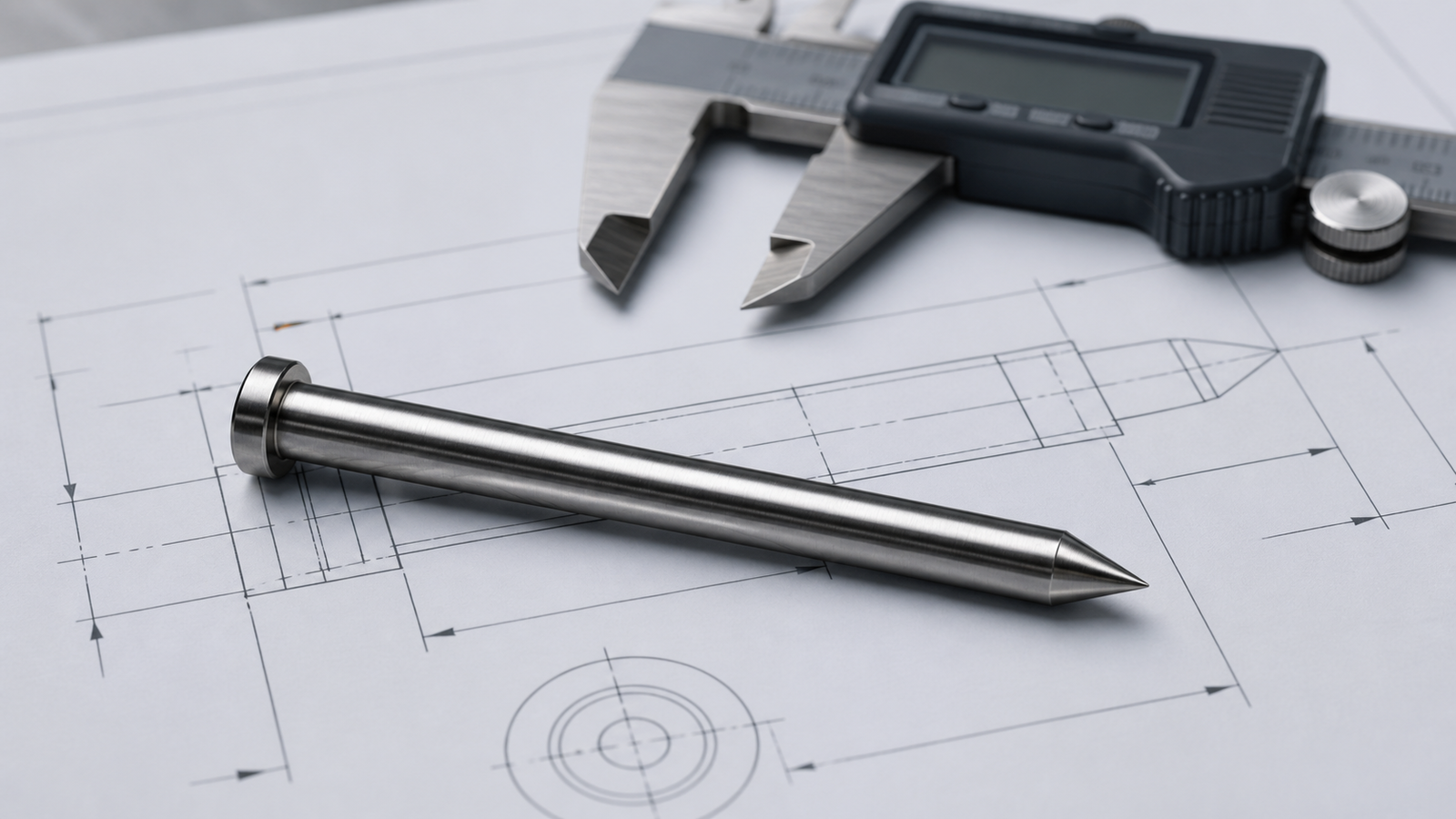
To specify a core pin, give the manufacturer five things: the working diameter and its tolerance, the overall length and any stepped sections, the head style, the tip or point geometry, and the material with its surface finish and any heat treat or coating. Provide those on a drawing, or send a sample pin to copy, and the shop can quote and build the part to that spec.
A core pin forms an internal feature in a molded or cast part, so its diameter, surface, and fit transfer directly into the parts the tool runs.
1. Diameter and tolerance
The working diameter is the number that forms the feature in the part, so it is the one to define most carefully. State the nominal diameter and the tolerance, and if a fit is critical, say so, since that drives how the pin is ground. Tell the shop whether the diameter is a slip fit, a press fit, or a clearance, and over what length the tolerance has to hold. We grind core pin diameters from 0.004 in up to 1.5 in and hold ground diameters as tight as 0.00005 in, so call out the real number your feature needs rather than rounding to something looser.
If the diameter steps down, dimension and tolerance each step separately. Holding size and roundness over a long unsupported length is a precision grinding problem.
2. Overall length
Give the overall length and, if the pin has steps, the length of each section. Note the datum you are measuring from so there is no ambiguity at the head. A long, slender pin sees deflection and heat on every shot, so reference everything to one clear datum rather than stacking dimensions feature to feature.
3. Head style
Most pins have a head that seats and retains them. Note the head type and dimensions, or reference the standard you are working to. If you are matching an existing pin, the head is often where small differences hide, so measure it carefully: a head a few thousandths too thick holds the plate open, one too thin lets the pin lift.
4. Tip or point geometry
Flat, radiused, chamfered, or a formed point: the tip shapes the bottom of the feature it cores. Call it out, with a drawing if the geometry is anything but flat. A flat tip leaves a flat-bottomed hole; a radius or chamfer breaks the edge or seals against a mating face; a formed point cores a cone or a vent. Where the tip meets a wall or a parting line, say how the two are meant to meet, since that controls flash.
5. Material, finish, and treatment
Note the material if you have a preference, the surface finish on the working diameter, and any hardening or coating. If you are not sure, describe the resin or alloy and the run length, and a good shop will recommend an approach. A glass-filled resin wears pins faster than an unfilled one, so a longer run usually argues for a harder pin or a coating.
What should you send for a quote?
The cleanest quote comes from a fully dimensioned drawing with tolerances, a datum, and the material and finish called out. Short of that, a marked-up sketch covering the five items above gets you most of the way. Note the quantity and whether this is a one-off or a repeating order. For a formed tip or a stepped diameter, send a detail drawing or a model so the feature is unambiguous.
No drawing? Send a sample
If you need the same pin again and have no print, send the worn pin. A grinding shop can reverse it to a quotable print and match it, rather than reconstructing a spec from memory. A sample also captures what a sketch misses: the head fit, the tip condition, the finish, and the wear pattern. If the original failed early, say so, since that argues for changing the material or treatment.
Frequently asked questions
Which dimension on a core pin matters most? The working diameter and its tolerance, because that is the feature the pin forms in the part. The other dimensions support holding that diameter to size.
Do I need a full drawing, or is a sketch enough to get a quote? A dimensioned drawing is ideal, but a clear sketch covering diameter, length, head, tip, and material is usually enough to quote. The harder the geometry, the more a drawing or a sample pays off.
Can you match a pin if I only have a worn sample and no print? Yes. A worn pin can be measured and reversed to a quotable print, and the working features matched to the original. Tell the shop if the original wore out early so the material or treatment can be reconsidered.
Ready to quote
Precision Core Pins builds core pins to print or to sample in Orange County, California, ground to tight tolerances and made in the USA. Call (714) 540-5621 or request a quote.