
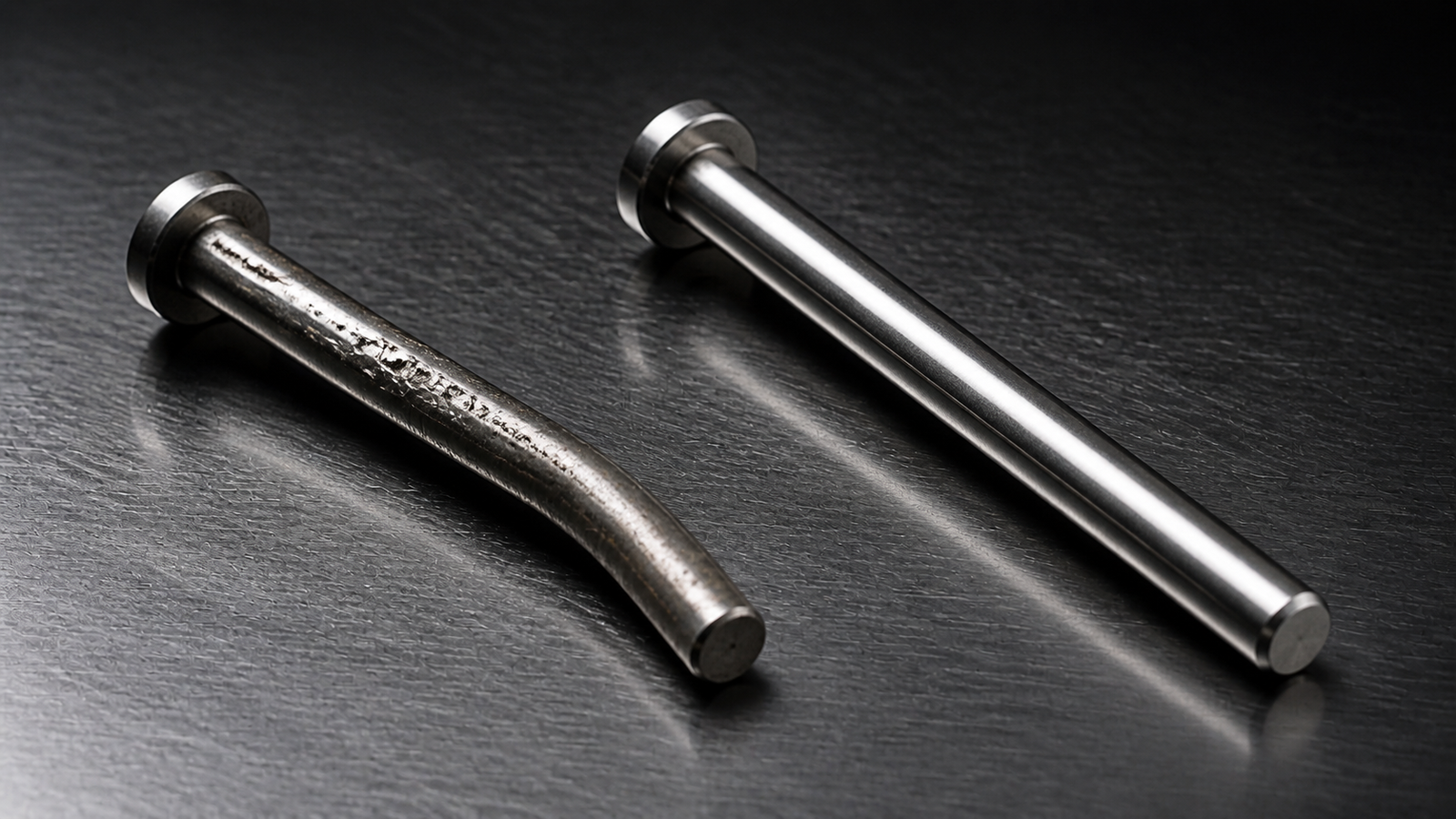
Ejector pins fail for a short list of reasons: they bend under load, gall against the hole, let flash creep down the bore, or leave marks on the part. Almost every one traces back to three controllable things: how the pin is designed into the tool, how it fits its hole, and what material and finish it is made from.
Why do ejector pins bend or break?
Long, thin pins under high ejection load can buckle, deflect, or snap. The usual triggers are unbalanced ejection, a part sticking in the cavity, or pins too small for the stroke and force they carry. The fixes are mechanical: use adequate pin diameter for the load and length, since stiffness climbs fast with diameter, and balance the ejector layout so force is shared rather than concentrated on a few slender pins. If the part is hard to release, fix the real cause, whether draft, polish, or venting, instead of pushing harder. A straight, hardened pin also deflects less than a soft one.
What causes galling and wear?
Galling is metal-to-metal welding and tearing between the pin and its hole, where the pin drags, scores its own bore, and eventually seizes. Common causes are a fit that is too tight, a rough surface finish, contamination from filled resins or shop dirt, and a pin that is not hard enough for the cycle count. Prevention is about fit, finish, and surface condition. The right running clearance lets the pin slide without binding, and a correctly ground finish reduces the high spots where galling begins. Appropriate hardness, and in some cases a surface treatment, raises wear resistance, which matters most with abrasive or glass-filled resins.
How do you stop flash around an ejector pin?
Flash down the pin happens when there is too much clearance between the pin and its hole, or when a once-correct hole has worn open. Plastic finds the gap and forms a thin fin or built-up ring that fouls ejection and shows on the part. The first defense is the correct fit from the start. Ejector pin clearance lives in tenths, which is why the working diameter is precision ground rather than just turned. The second is maintenance: replace a pin or hole worn past its fit window before the gap opens enough to flash. Because the failure is dimensional, so is the fix: hold the pin and hole to the fit they were designed around. We grind diameters as tight as 0.00005 in when an application calls for it, which holds the clearance inside the narrow window the fit was designed around.
What causes ejector pin marks on the part?
Ejector pin marks are the witness left where the pin pushes on the part, and they come in two flavors. Cosmetic marks are visible rings, halos, or drag lines on the surface. Dimensional marks are push or sink where the pin has deformed the part by carrying too much load on too little area. Several things drive them:
- Pins set proud or below flush stamp a ring or leave a small boss on every shot.
- Unbalanced ejection loads some pins far harder than others, so they print while others do not.
- Too few pins, or pins that are too small, concentrate force and push the part.
- A rough or worn pin face transfers its own texture to the part.
The fixes work the surface and the load together: set pins flush, balance ejection, and keep the pin face clean, since the part copies whatever the pin presents. When the pressure is too high for the area, spread the load with a larger ejection footprint, such as a blade, or add pins. On cosmetic surfaces the goal is a flush, correctly finished face, which comes back to precision grinding.
Heat and fatigue run underneath all four modes. Pins run hot, and over many cycles heat plus load fatigues an undersized or poorly treated pin until it cracks, so matching material and hardness to the application is the common defense.
Frequently asked questions
What causes ejector pin marks? Marks come from the pin pushing on the part: pins set proud or below flush, unbalanced ejection that overloads some pins, too few or too small pins concentrating force, and a worn or rough pin face. Setting pins flush, balancing ejection, spreading the load, and keeping the face correctly finished all reduce them.
How do you prevent ejector pins from bending? Use enough pin diameter for the load and length, balance the ejector layout so force is shared, and fix the real reason a part is hard to eject rather than increasing force. A straight, hardened pin also deflects less than a soft one.
What is the difference between galling and flash? Galling is wear from a fit that is too tight, a rough finish, or insufficient hardness, and it makes the pin drag or seize. Flash is plastic creeping down a gap when the fit is too loose or the hole has worn. The right clearance matters in both directions.
The common thread
Most ejector pin failures come down to fit, finish, straightness, and material, the same four things grinding controls. Precision Core Pins manufactures ejector pins to your print in Orange County, California, ground to the fit your application calls for. Call (714) 540-5621 or request a quote.