
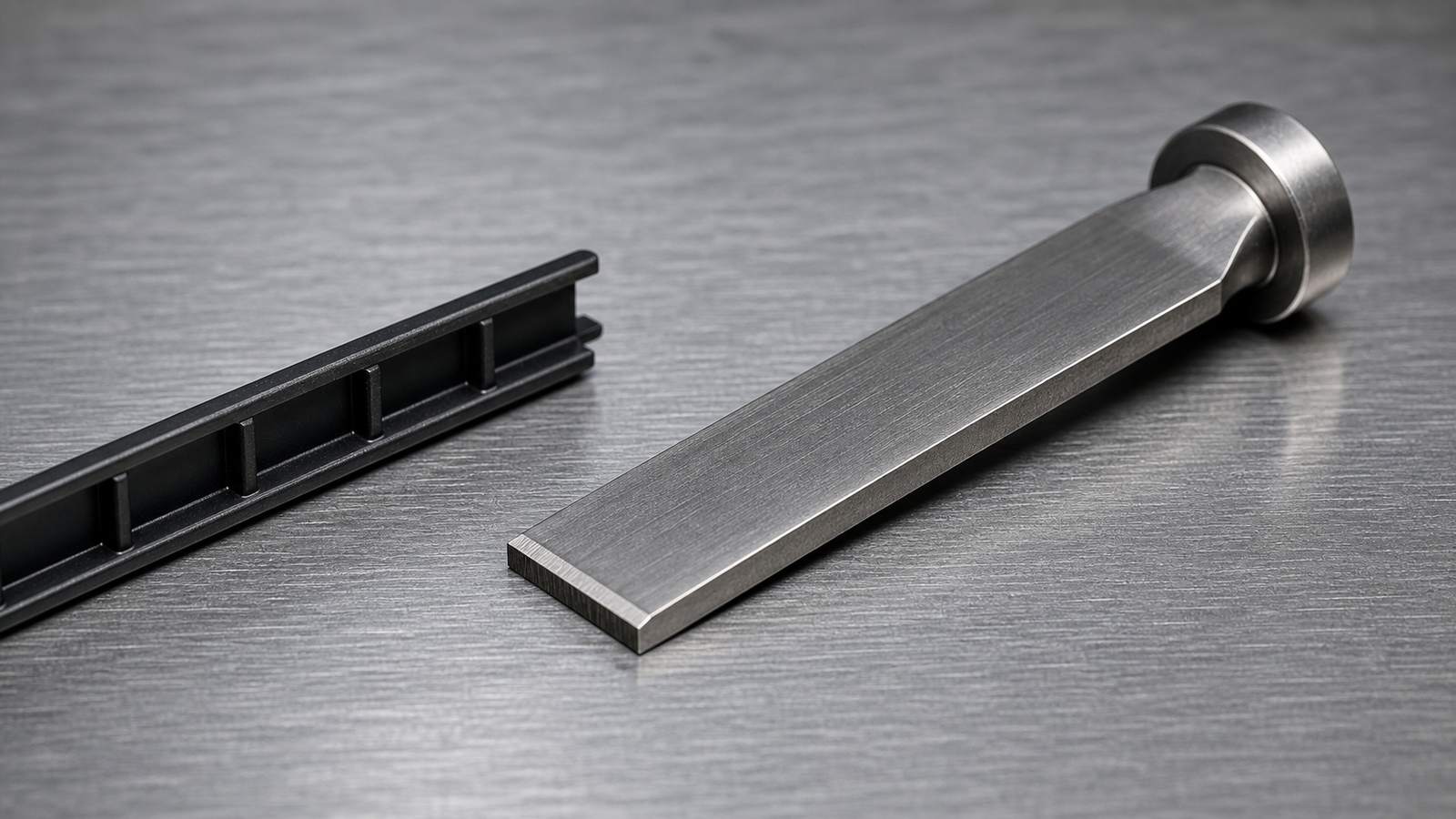
An ejector blade is a flat, rectangular ejector that pushes parts off the core where a round pin will not fit. You use one when the feature you need to eject is too thin or too narrow for any circular pin face, such as a rib, a gusset, or a thin wall. The blade reaches into the slim slot a round pin cannot enter and drives the feature off the core.
What is an ejector blade?
A blade is essentially a flat ejector pin. The working end is rectangular rather than round, so it can reach into a thin slot and push along a rib or wall. The other end carries a head that retains and drives it in the ejector plate, just like a standard pin, so it indexes and travels the same way the rest of your system does.
The difference is the working face. A blade presents a long, thin rectangle that sits directly under a feature with no flat circular area to push against, and it spreads the ejection load along a line instead of a single point.
Where do blades make sense?
- Ribs and gussets that are too thin for any round pin. The rectangular face follows the rib wall and pushes evenly along its length.
- Thin-wall parts where a round pin would mark or dimple the visible surface. A blade can sit on a hidden edge and keep the cosmetic face clean.
- Tall narrow features that need support along their length. A blade backs the feature over a longer run, which reduces the chance of bending or shearing the plastic as it releases.
If a round pin already does the job, there is no reason to switch. Use a blade where a round pin will not fit the geometry.
Where does the tolerance live, and why?
A round pin seals and slides on a diameter. A blade does it on flats, so the critical dimensions are thickness and width, held across the working length, with the faces kept square. The fit lives on two pairs of parallel faces, which is why a blade is a surface and form grinding job rather than a simple turned part. It has to slide freely in its pocket on every cycle and still close the gap tightly enough that molten plastic does not escape past it.
- Too thick and the blade binds in the pocket. You get drag, galling, and a blade that sticks or wears unevenly.
- Too thin and plastic flashes past the blade into the clearance. That flash builds up, fouls the pocket, and shows on the part.
Squareness matters as much as size. If the faces are not square to each other, the blade can fit on one measurement and still bind or leak because it sits cocked in the pocket. Holding thickness, width, and squareness together over the working length is what precision grinding is for. We can hold ground thickness and width as tight as 0.00005 in when the fit calls for it.
What should you specify on a blade?
Give the blade thickness, width, working length, the transition from the working section to the body, and the head style and dimensions. Note any draft or relief on the working end, and call out which faces are the controlled sealing faces if the part is not symmetric. Specify material and surface treatment if you have a preference; otherwise we can recommend based on the resin and cycle.
As with pins, a worn sample can be reversed to a print if you do not have a drawing. A blade that has worn out of tolerance or galled in service still carries the geometry we need: we measure the original thickness, width, and head, reconstruct the print, and grind a fresh blade to fit the existing pocket.
Frequently asked questions
What is an ejector blade? A flat, rectangular ejector pin. Its working face is a thin rectangle instead of a circle, so it fits into ribs, slots, and thin walls a round pin cannot reach.
When do you use a blade instead of a round pin? When the feature is too thin or narrow for a round pin face, or when a round pin would mark a cosmetic surface or put a point load on a fragile feature. If a round pin fits and ejects cleanly, keep it.
Why are blade tolerances on thickness and width instead of a diameter? A blade has no diameter. It seals and slides on flat faces, so the controlled dimensions are thickness and width held across the working length, with the faces square to each other.
Can a worn blade be reproduced without a drawing? Yes. A worn or galled blade still carries its original geometry. We measure it, reconstruct the print, and grind a replacement to fit the existing pocket.
Get blades made to your print
Precision Core Pins manufactures ejector blades to your print in Orange County, California, ground to the flat-on-flat fit your application calls for. Call (714) 540-5621 or request a quote.