
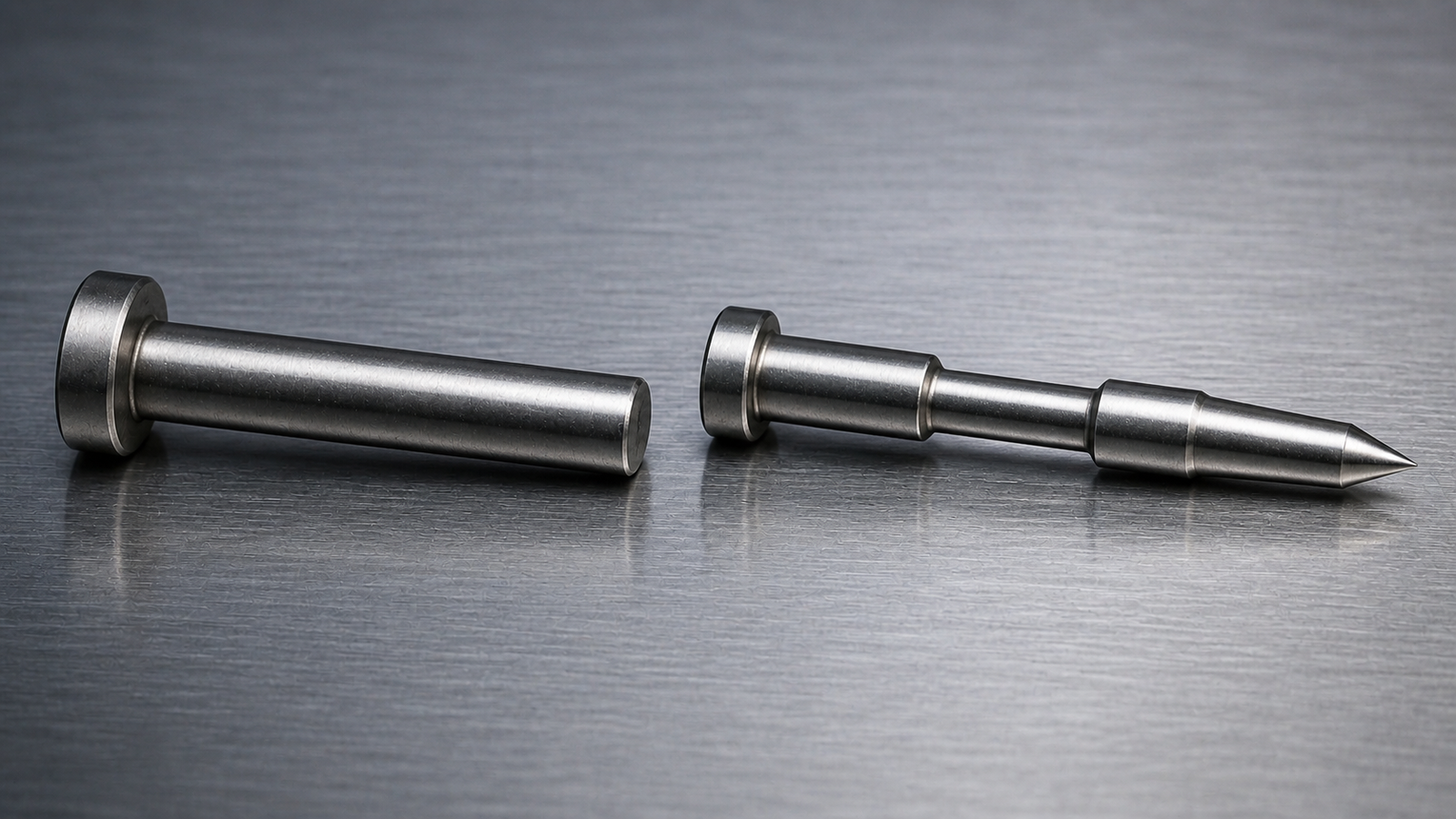
Order catalog when a standard pin in a standard size drops straight into your tool, since stock parts are usually in inventory. Order custom when the part falls between catalog sizes, needs special geometry or a material the catalog does not list, has to run matched to another component, or holds a tolerance the catalog class does not. The catalog covers the common cases; custom covers everything it leaves out.
What catalogs do well
Standard diameters, standard lengths, standard heads, held in inventory. For a common ejector pin in a common size, a catalog part is usually the right call. Catalog suppliers carry the sizes that show up in most mold bases, so when your tool was designed around those sizes, there is no reason to pay for custom work. The economics change when the standard part stops fitting.
When does off-the-shelf stop working?
A catalog part works until your geometry, your material, or your tolerance falls outside what the supplier stocks. These are the situations where a standard pin will not do the job:
- Non-standard dimensions. A diameter, length, or head between catalog sizes. Going up and turning it down adds a step and a chance to introduce error; going under leaves you short. A made-to-size pin starts at the dimension you actually need.
- Special geometry. A formed tip, a stepped profile, a relieved shank, or a blade cross-section no catalog lists. These features are part of how the part forms or ejects, so an approximation changes the part you mold.
- A specific material called out on your print. A steel grade matched to your resin or alloy and your expected cycle count, rather than whatever the stock part is made from. Catalog parts come in a fixed material for a given size.
- A long part. A mandrel up to 12 feet, or a core pin longer than any catalog stocks, ground straight and to size over its full length. Length like that is not something you pull off a shelf.
- A tolerance the catalog class does not hold. Catalog pins are sold to a standard class. When your fit needs to be held closer than that class guarantees, a custom-ground part made to your print is the way to get there. We hold ground diameters as tight as 0.00005 in.
- A tool that is down now. A worn or broken pin with no catalog equivalent, where copying the original from a sample is the fastest path back to running.
What does forcing a fit actually cost?
Modifying a catalog pin, or accepting one that is almost right, rarely stays a small compromise. Extra clearance, a wrong finish, or a head that does not seat shows up downstream as flash, drag, galling, or pin marks on the part, defects you then chase on the molding floor after the tool is already in the press.
The real number is downtime. A mold that is down for a part that does not fit is not making parts, and on a high-volume tool that idle time is usually worth far more than the difference between a catalog pin and a custom one. Compare the total cost of getting the tool running correctly, not just the line-item price of the pin.
How a custom shop bridges the gap
A custom shop builds the part to match your job in one of two ways. Made to print: you supply the drawing with dimensions, tolerances, and material, and the part is ground to that print. Reverse-engineered from a sample: you send the worn or original part, and it is measured and reproduced when no drawing exists. Both paths end with a component made to your print or sample. The products and capabilities pages lay out what can be made to print or copied from a sample.
Frequently asked questions
When should I order a custom mold component instead of catalog?
Order custom when the part falls outside what the catalog stocks: a non-standard diameter or length, special tip or head geometry, a worn part with no catalog equivalent, or a tolerance closer than the catalog class holds. If a standard part in a standard size fits, catalog is the better buy.
Is a custom pin always more expensive than catalog?
On the line item, usually yes, because it is made to spec rather than pulled from stock. On total cost, not always. A part that fits and runs the first time avoids the rework, scrap, and downtime that often outweigh the price difference.
Can you make a part if I do not have a drawing?
Yes. A worn or original part can be measured and reproduced from the sample, so no drawing is required to get a copy made.
What do I need to provide for a part made to print?
The dimensions and tolerances, the material or steel grade, and any special geometry. Send the print, or if you only have a sample, send the part instead.
Custom, made in the USA
Precision Core Pins manufactures core pins, mandrels, ejector pins, and blades to your print or sample in Orange County, California, ground to tight tolerances and made in the USA. When the catalog does not have it, that is the work we do. Call (714) 540-5621 or request a quote.