
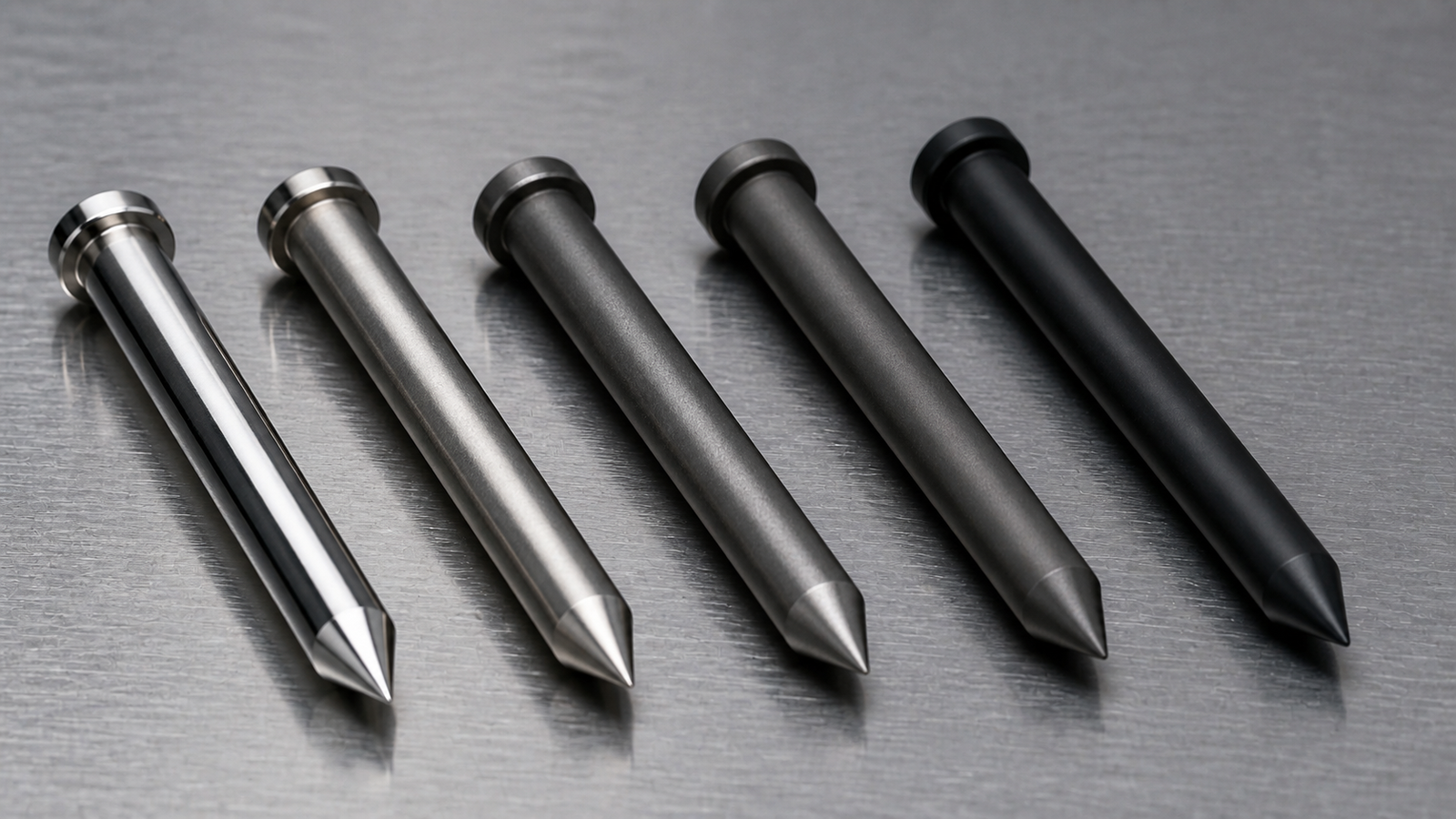
The right material for a pin comes down to three things: what resin it runs in, how many cycles it has to survive, and what the application does to it through heat, load, and corrosion. Abrasive or filled resins and long production runs push you toward harder steels and surface treatments, while corrosive environments push you toward stainless or a protective coating. You do not need to name a grade to get a good quote, but understanding the trade-offs helps you describe the job well.
What drives the choice?
A pin fails in a few predictable ways: it wears out of tolerance, it galls and seizes, it corrodes, or it fatigues and breaks. Material selection is really about matching the steel to whichever of these your application threatens most.
- Resin and fillers: glass-filled, mineral-filled, and flame-retardant resins are abrasive and wear pins faster, which pushes toward harder materials and surface treatments. Unfilled commodity resins are far gentler.
- Run length and cavitation: a short run and a multi-million-cycle, high-cavitation production tool have very different wear demands. The more shots the pin sees, the more the up-front investment in a harder, treated surface pays back.
- Corrosion: some resins outgas corrosive byproducts, and humid plant environments or water-cooled tools add their own exposure. These call for stainless or a corrosion-resistant treatment.
- Heat and load: hotter, higher-load applications, including die casting, favor materials that hold hardness at temperature and resist thermal fatigue.
Wear resistance versus toughness
This is the central trade-off in pin material selection. Harder steels resist wear and abrasion well but become more brittle, so a slender pin in a high-load position can chip or snap. A tougher, slightly softer steel survives shock and bending but wears faster against an abrasive resin. The right answer depends on geometry: a long, thin ejector pin in a filled resin is a different problem than a short, stout core pin in an unfilled one. Describing the pin’s size, length-to-diameter ratio, and where it sits in the tool is as useful as naming a steel.
Which tool steels are common, and why?
As general industry background, several families show up repeatedly in mold and die-cast components. H13 is a hot-work tool steel valued for holding hardness at elevated temperature and resisting thermal fatigue, which is why it is common in die casting and demanding mold work. S7 is a shock-resistant grade chosen where toughness matters more than maximum wear resistance. M2 and other high-speed steels run very hard and resist wear, at the cost of toughness. Where corrosion is the concern, hardenable stainless grades like 420 trade some wear resistance for protection. These are general engineering reference points, not a statement of what any one shop stocks.
How do hardness and surface treatment fit in?
Pins are typically hardened on their working surfaces so they resist wear and galling, and a surface treatment can add a hard, low-friction skin over a tougher core. Nitriding diffuses nitrogen into the surface to raise hardness and reduce friction without the dimensional change of through-hardening. Thin-film coatings such as nitrides applied by PVD can add a very hard, slick face for abrasive resins. Black oxide and similar treatments add modest corrosion and galling resistance. The goal is the same in every case: a pin that keeps its fit and finish across the run rather than wearing into flash, drag, and short shots.
Why does surface finish matter alongside the steel?
Surface finish affects how a pin runs. A ground finish lets a hard pin slide in its bore and release the part. Too rough and the pin galls and the part sticks; the wrong lay can trap resin and accelerate wear. Material, hardness, and finish work together. Pins are made to print and ground to tight tolerances, with ground diameters held as close as 0.00005 in.
Let the application lead
If you are not sure what to specify, describe the resin and whether it is filled, the expected run length, and the operating environment. The more you can say about how the pin will be used, the better the description on the print. For a related decision, see the core pins line and how tolerances match the job.
Frequently asked questions
Do I have to specify a steel grade to get a quote?
No. If you describe the resin, run length, and environment, a good shop can recommend a material and treatment. A specified grade on your print is welcome but not required.
Which is better, a harder pin or a tougher one?
Neither is universally better. Harder steels resist wear but are more brittle; tougher steels survive shock and bending but wear faster. The right choice depends on the pin’s geometry and the load it sees.
Why do glass-filled resins wear pins faster?
The glass fibers are abrasive and act like fine grit moving across the pin surface every cycle. Filled and flame-retardant resins generally call for harder materials, a surface treatment, or both.
Does a surface coating replace a good base material?
No. A coating or treatment adds a hard, low-friction surface, but the core steel still has to provide the strength and toughness for the geometry and load. The two are selected together.
Can stainless pins solve corrosion problems?
Stainless or a corrosion-resistant treatment helps where the resin or environment is corrosive, but stainless grades often trade away some wear resistance, so the choice still balances against abrasion and load.
Talk it through
Precision Core Pins manufactures core pins and ejector pins to your print in Orange County, California. Call (714) 540-5621 or request a quote.